A Golden Opportunity · Doctoral Study in India
Earn your doctorate on a government scholarship — at almost no cost.
India funds thousands of doctoral seats every year through UGC, CSIR, ICSSR, PMRF and state schemes — tuition waived, a monthly stipend paid, a contingency grant provided. Most eligible aspirants never claim them. This consultancy exists to make certain that you do.
Direct WhatsApp with Dr. Neeraj Sharma · +91 97569 66938
(a) The Opportunity
Why this moment favours the doctoral aspirant.
Expanded funding capacity
The National Education Policy has widened research funding across central and state universities. Seats now exist in disciplines that were historically unfunded, and a substantial share go unclaimed each cycle for want of qualified applications.
A stipend, not a fee
A fellowship reverses the economics of higher study. Rather than paying tuition, you receive a monthly stipend, an annual contingency grant for fieldwork and conferences, and in many cases housing within the institute.
The doctorate as a threshold
A PhD is now the entry condition for professorship, senior research posts, policy advisory roles and industrial R&D leadership. It compounds in value across an entire career.
(b) Reference Table
Government fellowships, compared.
Indicative figures under current central and state schemes. Final terms follow the notification of the awarding body and your admitting institution.
| Scheme | Stipend | Tenure | Cycle |
|---|---|---|---|
| UGC-NET JRFPost-graduates, all disciplines | ₹37,000 / month | 2 + 3 years | Jun & Dec cycles |
| CSIR-UGC JRF / SRFScience & engineering streams | ₹37,000–42,000 | 2 + 3 years | Twice yearly |
| ICSSR Doctoral FellowshipSocial sciences & humanities | ₹20,000–25,000 | 2 years | Annual notification |
| PMRFIITs, IISc, NITs & IISERs | ₹70,000–80,000 | Up to 5 years | May & Dec channels |
| State & Institutional SchemesResident and category-based awards | Fee waiver + allowance | 2–3 years | State-specific |
Figures are indicative and subject to revision by the respective funding agency.
(c) The Complete Research Ecosystem
From admission to the award of the doctorate.
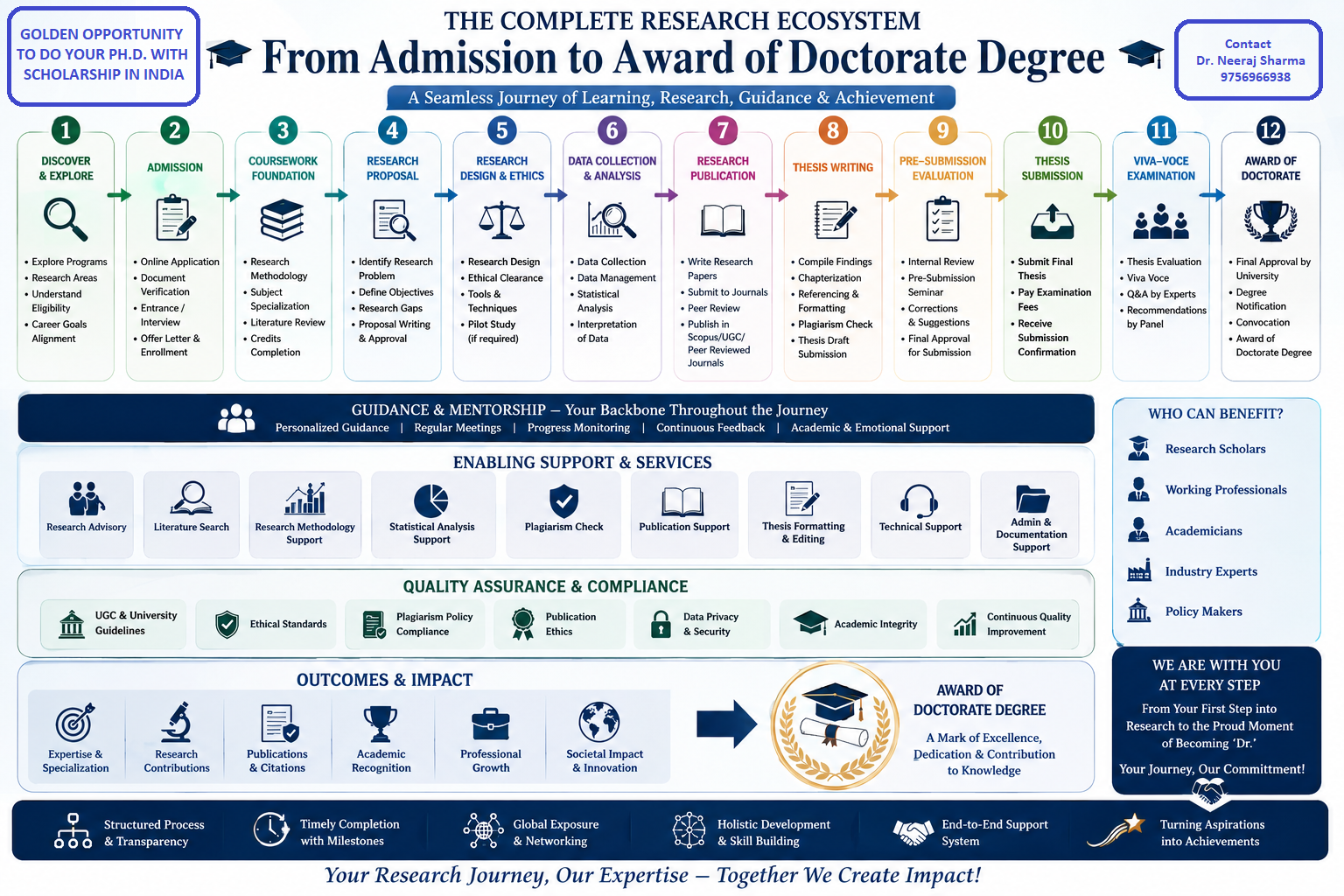
Twelve stages, one continuous system of guidance. The chart below sets out the entire journey — discovery, admission, coursework, proposal, design, data, publication, thesis, evaluation, submission, viva-voce and conferment — alongside the support services and compliance standards that accompany each stage.
(d) The Admission Roadmap
Six stages to a funded seat.
- 01
Eligibility & profile audit
Your marks, NET/GATE status, publications and work experience are mapped against every scheme's threshold to identify the two you can realistically win.
- 02
University & supervisor matching
A shortlist of central, state and private universities with active funded seats, matched to your discipline and to supervisors accepting scholars this cycle.
- 03
Research proposal & synopsis
A defensible proposal — problem statement, objectives, literature gap, methodology — drafted to the selection committee's rubric and revised across two review rounds.
- 04
Application & fellowship filing
Portal submissions, document verification, category certificates and fellowship nominations, each tracked against its closing date.
- 05
Entrance & interview preparation
Written-test orientation, mock panels and rehearsed answers to the questions committees actually ask about your proposal.
- 06
Enrolment & stipend activation
Offer review, joining formalities, fellowship disbursement paperwork and the annual reporting that keeps your grant running without interruption.
(e) Enabling Support
Services that carry the scholar through.
Research Advisory
One-to-one counsel on discipline, specialisation and career direction.
Literature Search
Structured search of indexed databases to establish your research gap.
Research Methodology
Design, sampling, instrumentation and analytical framework support.
Statistical Analysis
SPSS, R and AMOS support for quantitative and mixed-method work.
Plagiarism Compliance
Similarity screening aligned to UGC and university policy.
Publication Support
Guidance for Scopus, UGC-CARE and peer-reviewed journal submission.
Thesis Formatting
Chapterisation, referencing and pre-submission editorial review.
Documentation Support
Admission, scholarship and examination paperwork, handled end to end.
(f) Your Practitioner
“Most doctoral admissions are lost at a threshold, not for want of talent. My work is to know precisely which threshold you stand at — and to carry you across it.”
Fellowship windows close on fixed dates and funded seats are allocated first. A first consultation is confidential and without obligation.
WhatsApp +91 97569 66938(g) Enquiries
Questions aspirants ask.
- Can a doctorate in India genuinely be free?
- For a fellowship holder, effectively yes. Government schemes reimburse or waive tuition at most public universities and add a monthly stipend plus an annual contingency grant. The cost that remains is your time and your work.
- I have not cleared UGC-NET. Am I still eligible?
- Yes. NET-JRF is one route among several. State fellowships, institutional assistantships, project-based positions and category-specific awards admit candidates without NET, and several universities conduct their own funded entrance examinations.
- Can I pursue a PhD while employed full-time?
- Many universities offer part-time or external registration for working professionals, subject to a no-objection certificate. Fellowship eligibility differs for this route, and we assess it during the profile audit.
- How long does the admission process take?
- From first consultation to enrolment, a typical cycle runs four to eight months, governed by university notifications and fellowship windows. Beginning early is the single largest determinant of success.
- What support continues after admission?
- Guidance continues through coursework, proposal approval, data analysis, publication, thesis submission and the viva-voce examination — the full ecosystem shown above.
Your research journey, our expertise — together we create impact.
Send a message with your qualification, subject and city. You will receive an honest assessment of the fellowships within your reach and the next step to take.
Message Dr. Neeraj Sharma on WhatsApp+91 97569 66938